


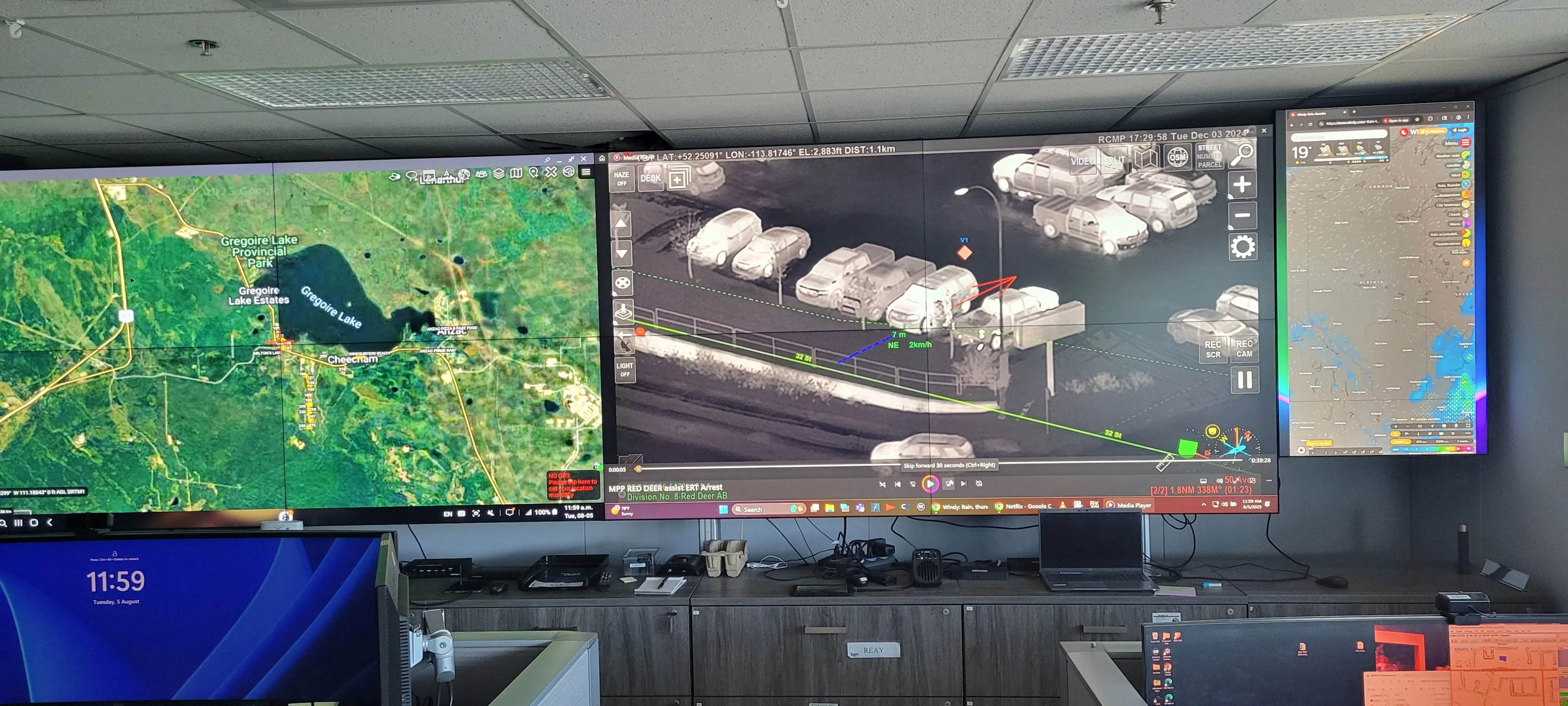
RCMP K-Div Real Time Operations Centre
Inside the RCMP’s Real Time Operations Centre, where cutting-edge technology meets tactical precision
With satellite mapping, real-time analytics and 24/7 coordination, Alberta’s RTOC gives police an unmatched operational advantage
EDMONTON — In Alberta’s capital, across from the bustle of Kingsway Mall and surrounded by traffic and construction, sits a sleek glass and brick building that houses something few Albertans have ever seen.
It is the headquarters of the Alberta RCMP, and deep inside its maze of corridors and offices lies a room unlike anything else in the force’s infrastructure. It is called the Real Time Operations Centre, or RTOC, and stepping inside feels more like walking onto a movie set than into a police facility.
With floor-to-ceiling monitors, rows of glowing workstations and satellite maps displaying live updates of activity across the province, the room hums with energy. Staffed 24 hours a day by experienced RCMP officers, dispatchers, criminal intelligence analysts and an IT team, RTOC is the tactical brain of the RCMP in Alberta and the Northwest Territories.
This is where technology, training and real-time information converge to create a powerful operational edge in the field. As Inspector Ryan Breitkreuz, Officer in Charge of RTOC, explains, the centre’s role is to provide instant support to officers during unfolding events, especially those the RCMP classifies as Level 1 incidents. These are high-stakes situations requiring immediate and complex responses.
Harvard Media was given exclusive access to the centre, which has been fully operational since 2022. The experience, much like the centre itself, was unforgettable.
“RTOC is a force multiplier,” said Breitkreuz. “For an officer in the field, K Division’s RTOC and the resources and expertise we can provide are available at the push of a button.”
In policing, a force multiplier refers to anything that helps officers do their job more effectively without adding more people. It could be police dogs, drones, surveillance cameras or even partnerships with social agencies. These tools enhance awareness, speed up response times and improve outcomes, allowing smaller teams to handle complex events with precision.
And that precision is built into every detail of RTOC. Staff can track every RCMP officer in the province and in the Northwest Territories on a live satellite map. Officers appear as colour-coded icons depending on their unit type, from general duty members to canine handlers or tactical teams. The system can instantly show where each resource is, what it can do and how quickly it can respond.
If a major incident occurs, RTOC can preposition unmarked vehicles, activate aerial surveillance, alert canine teams and coordinate ground units in real time, all while keeping officers updated and supported as events unfold. The communication is seamless, fast and guided by experience.
Breitkreuz demonstrated how it works by walking through footage from a carjacking that took place in Red Deer last winter. The suspect was potentially armed, the area was densely populated and the threat was serious. Using aerial assets, live feeds and coordinated units on the ground, RTOC helped bring the incident to a close safely, without public disruption.
What surprised this reporter most was how far-reaching RTOC’s capabilities are. The centre can reach beyond policing, contacting support agencies like social services when required. It also gathers open-source intelligence, including monitoring social media, to give officers every possible advantage in the field.
“It’s not just about catching the suspects,” said Breitkreuz. “It’s about doing it smartly, safely and effectively.”
That approach saves time, money and lives. In 2024 alone, RTOC supported more than 15,000 operational events and helped save $750,000 in public funds by using strategic deployments, expert oversight and smart resource allocation.
“If I take one of my most experienced RTOC Staff Sergeants and put them in the Wood Buffalo detachment, their experience would certainly benefit Fort McMurray Wood Buffalo,” said Breitkreuz. “But by utilizing their skills in RTOC, their experience benefits every officer in the field.”
RTOC also works in sync with other police forces across Alberta, allowing for unified responses that improve public safety for everyone.
In part two of this series, Harvard Media will examine real-life cases where RTOC made a direct difference in police operations and in the lives of Albertans. But one thing is already clear: this is not the future of policing, it is the present, and it is here every hour of every day, ready to act when Albertans need it most.


Comments