


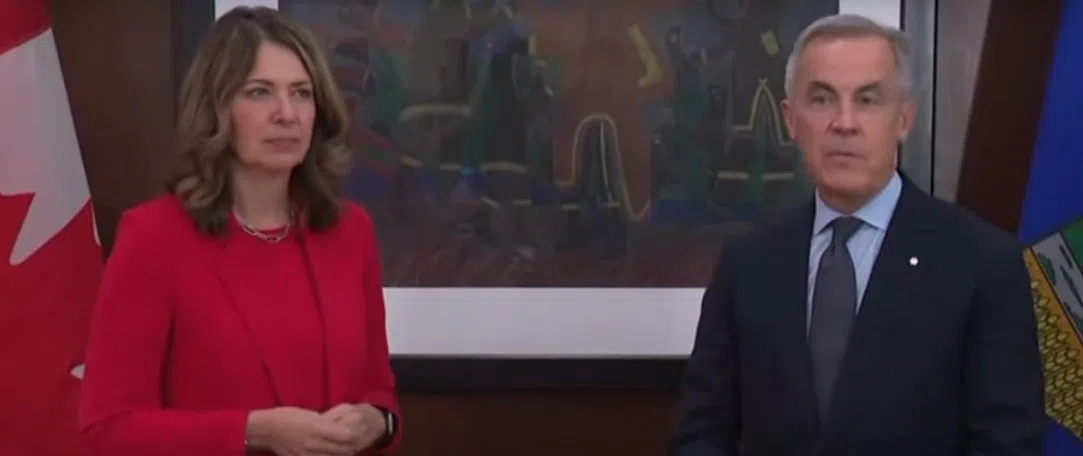
Premier Smith with PM Mark Carney, Oct 2025
PARIS — Mark Carney says Canada’s oil sector will remain competitive even if a revitalized Venezuelan industry re-enters global markets, arguing Canadian crude is cheaper, cleaner and carries far less political and security risk.
Speaking at a Jan. 5 press conference held in Paris, Carney said he is not concerned recent moves by U.S. President Donald Trump to seize control of Venezuela’s oil sector will undercut Canadian exports.
Canadian oil, he said, has become increasingly low cost as producers reduce marginal expenses, while large-scale carbon capture projects promise further emissions reductions.
Carney said those factors make Canada’s oil competitive over the medium and long term, particularly as global buyers seek reliable supply from stable jurisdictions.
Trump has said U.S. companies would move into Venezuela to repair infrastructure and oversee oil production following the arrest of Venezuelan leader Nicolás Maduro. The comments raised concern among some analysts and politicians that Venezuelan heavy crude could displace Canadian barrels in U.S. refineries designed to process similar grades.
Carney dismissed that risk, saying Canada has already taken steps to diversify energy exports beyond the United States and expand access to Asian markets.
He pointed to a memorandum of understanding signed in November with Alberta Premier Danielle Smith outlining conditions for a potential new bitumen pipeline to the B.C. coast. The agreement includes commitments to higher industrial carbon pricing and the development of Pathways Plus, a carbon capture and storage project aimed at lowering oilsands emissions.
Canada’s oilsands currently produce close to five million barrels per day, with most exports flowing south. Venezuela, despite holding the world’s largest proven crude reserves, produced about 900,000 barrels per day last year, far below levels seen in the late 1990s.
Carney said years of political instability, corruption, sanctions and security challenges have made Venezuela a far riskier environment for investment than Canada. He added that a post-Maduro Venezuela producing more oil would ultimately benefit its population and the wider hemisphere.
Conservative Leader Pierre Poilievre offered a different assessment, warning Venezuelan heavy crude could rapidly return to U.S. refineries and compete directly with Canadian supply. In a letter posted to social media, Poilievre urged immediate approval of a new west coast pipeline and dismissed the Alberta agreement as largely symbolic.
Carney, who was in Paris attending meetings on security guarantees for Ukraine, said Canada’s strategy rests on offering a reliable, lower-risk energy product while continuing to diversify export markets.


Comments