


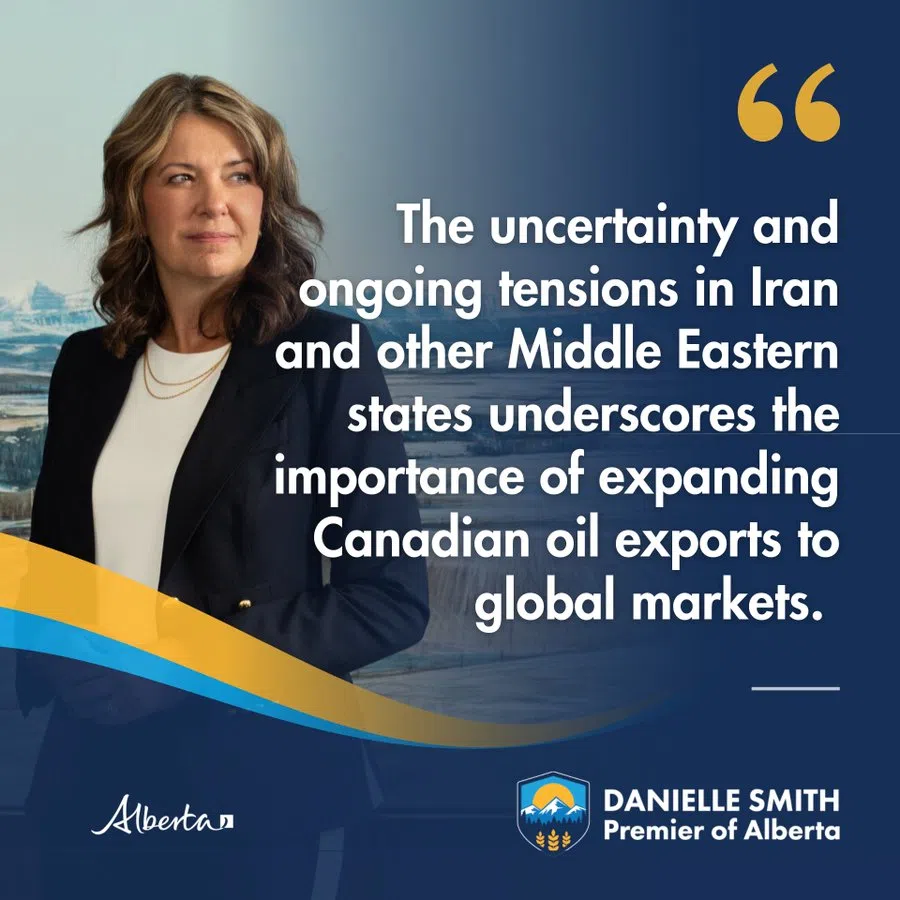
Premier Danielle Smith via x.com
EDMONTON — Alberta Premier Danielle Smith says tensions in the Middle East underscore the need for Canada to expand oil exports and build new pipeline capacity to the West Coast to reach Asian markets.
In a post on the social media platform X, Smith said uncertainty involving Iran and other Middle Eastern states highlights the vulnerability of global energy supply routes and strengthens the case for additional export infrastructure from Alberta.
“The uncertainty and ongoing tensions in Iran and other Middle Eastern states underscores the importance of expanding Canadian oil exports to global markets,” Smith said.
She said Asian countries source about 60 per cent of their oil from Middle Eastern producers and argued Alberta could help improve global energy security.
“To do this we must build the one million barrel per day pipeline from Alberta to Canada’s west coast,” Smith said.
She said the province expects to submit an application for the project by June and is seeking quick approval from the federal government.
Conservative MP Laila Goodridge, who represents the oil sands region of Fort McMurray–Cold Lake, said recent global tensions reinforce the argument for expanding Canadian energy exports.
“The world needs more Canadian oil and gas. This is more true with each passing day,” Goodridge said in a statement.
She added Canada should move quickly to build new pipeline infrastructure.
“The best time to have built a pipeline was yesterday and the next best time is today.”
The proposed pipeline would move crude from Alberta’s oil sands to tidewater in British Columbia, allowing producers greater access to overseas markets.
A Financial Post report this week said a proposed pipeline from Alberta to the B.C. coast could cost between $20 billion and $30 billion and may require foreign investment to finance a project of that scale.
Smith has said foreign investment could play a role in funding the project, though allowing state-owned companies to take ownership stakes in a major Canadian energy asset could spark political debate.
Goodridge also said the oil sands region remains central to Canada’s energy supply.
“Fort McMurray has the third largest proven oil reserve in the world. We also have incredibly hard working people who show up for their shifts through tough weather to make sure our furnaces and lights can stay on,” she said.
The renewed push for export infrastructure comes as tensions in the Middle East have drawn attention to the Strait of Hormuz, a key shipping route through which roughly one-fifth of the world’s oil and natural gas passes.
Analysts with the Institute for Research on Public Policy say disruptions or instability affecting major Middle Eastern shipping routes can heighten concerns about energy security among importing countries and increase interest in stable suppliers.
Canadian crude exports to China have grown in recent years, reaching about 200,000 barrels per day after the Trans Mountain pipeline expansion began operating.
Supporters of additional pipeline capacity say Alberta’s oil sands represent long-life resources that could provide stable supply for decades.
Critics say building new oil infrastructure risks locking in fossil fuel production at a time when governments are trying to reduce greenhouse gas emissions.


Comments