


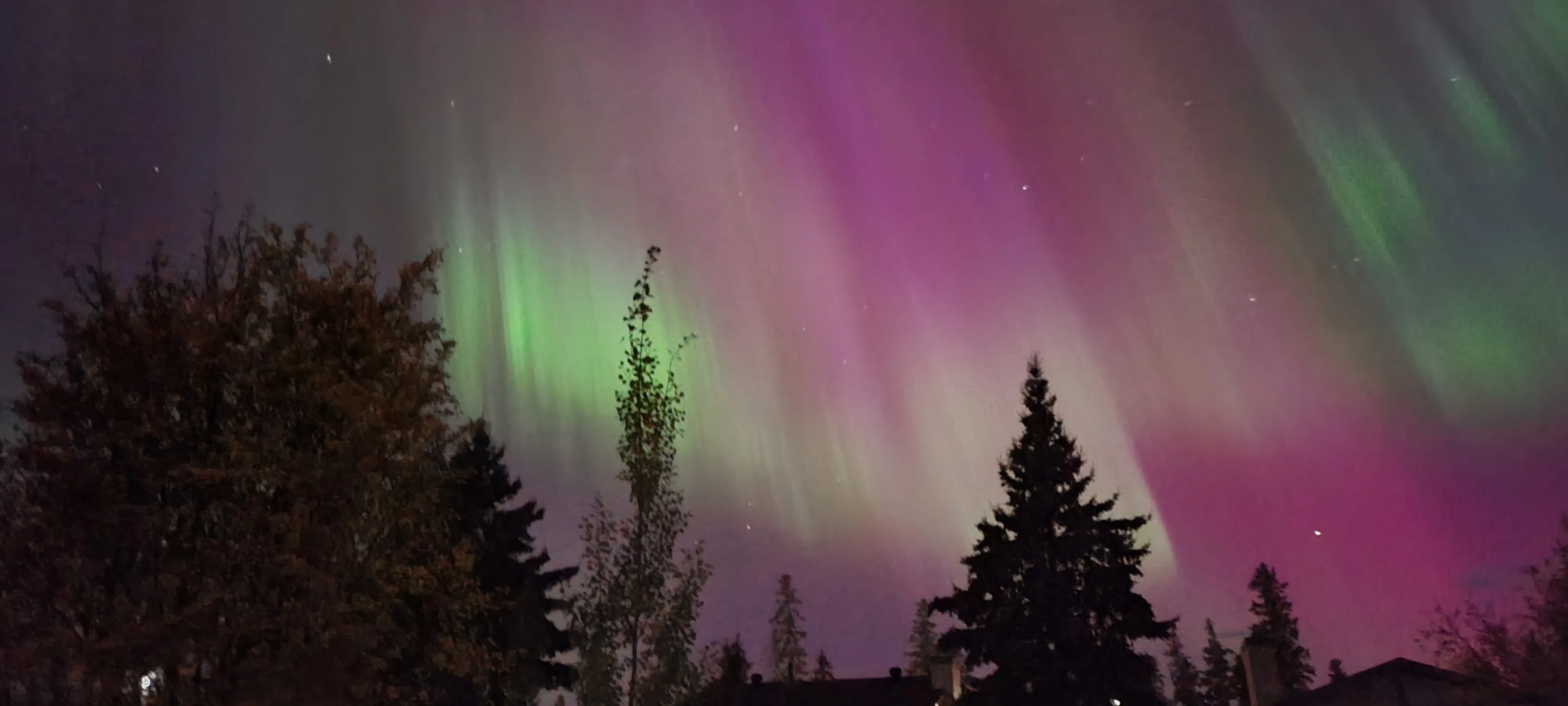
FORT McMURRAY — A massive solar storm, called a coronal mass ejection, has lit up skies across Canada and pushed the northern lights deep into the southern United States in one of the strongest geomagnetic storms of the current solar cycle.
Space weather agencies across the globe say at least two Earth-directed CMEs arrived Tuesday, carrying unusually dense plasma and magnetic fields far stronger than normal levels. The storm reached G4 intensity on the U.S. National Oceanic and Atmospheric Administration’s scale and produced widespread auroras from Alberta and Saskatchewan to Texas, Florida and the Gulf Coast.
Forecasters say more activity is expected. Additional solar eruptions are still making their way toward Earth, which could extend aurora displays through Wednesday and Thursday nights, especially in northern regions such as Fort McMurray and Wood Buffalo.
Richard Covey a member of the Royal Astronomical Society of Canada and an avid solar photographer, says the conditions are ideal for multiple nights of vivid skies.
“This is exactly the kind of solar setup that produces back-to-back auroras,” Covey said. “When several CMEs stack up like this, the magnetic field stays disturbed and the lights can stay active for days.”
Covey says residents in Fort McMurray should have a good chance of seeing the lights again, provided clouds stay away.
“People in the north are perfectly positioned for this,” he said. “If the sky clears, you could be looking at something unforgettable.”
The latest storms come during a period of intense solar activity as the sun approaches the peak of its 11-year cycle. Past events have had far-reaching impacts. The 1859 Carrington Event, the most powerful geomagnetic storm on record, sparked auroras as far south as Hawaii and set telegraph lines on fire. A smaller but still severe storm in 1989 caused a major power outage across Quebec.
Scientists say today’s technology is more vulnerable than in the nineteenth century, with satellites, power grids and communications systems all at risk during extreme space weather.
For now, forecasters say the biggest effect for Canadians will likely be the continued chance to see the aurora over the next few nights, particularly away from city lights and under clear skies.


Comments