


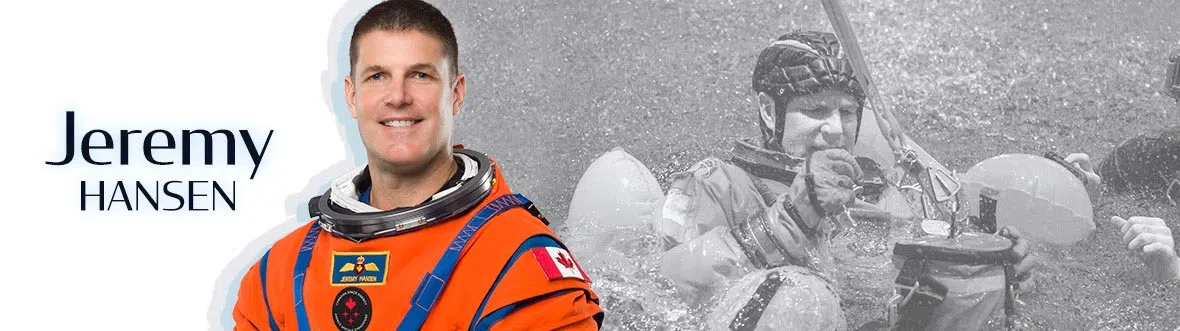
OTTAWA — We’re just a short month until Canadian astronaut Jeremy Hansen is set to blast off for the moon, making history as the first Canadian and first non American to take part in a lunar mission.
If current schedules hold, NASA’s Artemis II mission could launch as early as Feb. 6, sending four astronauts on the first crewed flight around the moon since Apollo 17 in 1972. The nearly 10 day mission will lift off from Florida aboard NASA’s Space Launch System rocket, carrying the Orion spacecraft deep into lunar space before returning to Earth with a Pacific Ocean splashdown off the coast of California.
Artemis II will mark a milestone for Canada’s space program. Hansen, a Royal Canadian Air Force fighter pilot and veteran astronaut, will fly alongside NASA astronauts Reid Wiseman, Victor Glover and Christina Koch. The mission is designed as a full systems test of Orion, including life support, navigation and manual flight controls, before future missions attempt a lunar landing.
After launch, Orion will orbit Earth twice to allow crews to verify spacecraft performance while still close to home. A powerful engine burn will then send the capsule on a free return trajectory around the far side of the moon, looping it back to Earth without entering lunar orbit. At its most distant point, Orion will travel more than 10,000 kilometres beyond the moon, with the crew covering over one million kilometres in total.
For Hansen, the mission has been years in the making. In interviews with CBC Radio, he has described the final phase of training as both exhilarating and sobering, as simulations give way to the reality of managing risk in deep space. Unlike earlier Apollo missions, Artemis II will combine elements of Apollo 7 and Apollo 8, testing spacecraft systems in Earth orbit before committing to the journey around the moon.
The mission also carries a strong scientific focus. The crew will conduct biological experiments, including the AVATAR study, which compares how space radiation affects astronauts and lab grown replicas of their cells carried aboard the spacecraft. Scientists hope the results will help prepare for longer missions, including future trips to the lunar surface and eventually Mars.
Artemis II is part of NASA’s broader Artemis campaign, aimed at establishing a sustained human presence on the moon. Canada’s involvement, including its contribution of the Canadarm3 robotics system, has secured future seats for Canadian astronauts on missions to the lunar Gateway space station.
Hansen has said his role represents more than a personal achievement, calling it a reflection of Canada’s long standing contributions to space exploration, from early satellite communications to pioneering space robotics.
If the timeline holds, the countdown now stands at weeks, not years, before a Canadian once again helps push humanity farther into space than ever before.


Comments