


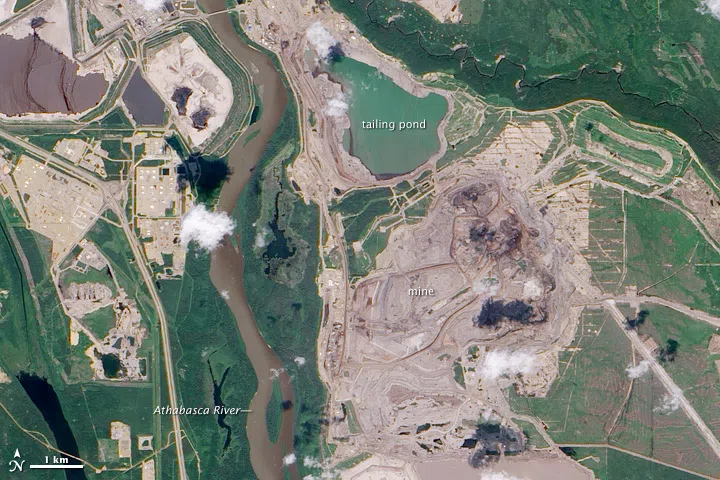
By NASA Earth Observatory - http://earthobservatory.nasa.gov/IOTD/view.php?id=40997, Public Domain
FORT McMURRAY — Alberta’s government says it will invest $46 million in new technologies aimed at reducing oilsands tailings ponds and cleaning mine water in northern Alberta.
The funding will be provided through the province’s Technology Innovation and Emissions Reduction program and will support nine projects led by oil companies, businesses and a post-secondary institution.
Environment and Protected Areas Minister Grant Hunter said the projects are intended to develop technologies to treat oilsands mine water and help reclaim land used by tailings ponds.
“The world is looking for responsibly produced energy, and Alberta is delivering,” Hunter said in a statement. “With industry leadership and TIER investment, we’re deploying technologies that clean up mine water, protect land and water, and deliver the jobs and competitiveness Alberta needs.”
According to the province, the funding will support projects designed to remove bitumen and chemicals from mine water, accelerate the settling and drying of tailings and use wetlands to naturally treat contaminated water.
Brian Jean, Alberta’s minister of energy and minerals, said the investment reflects the province’s approach to environmental management within the oilsands sector.
“Alberta is the most responsible energy producer in the world, and we are committed to the protection of our water and environment in every project,” Jean said.
Fort McMurray-Wood Buffalo MLA Tany Yao said the projects are aimed at reducing the environmental footprint of oilsands operations while maintaining energy production.
“These projects will help us continue to provide the responsible energy that communities and the world need, all while protecting our environment and water for future generations,” Yao said.
The projects will be delivered through Emissions Reduction Alberta, a provincial agency supporting energy and environmental innovation.
Justin Riemer, the agency’s chief executive officer, said the funding will support technologies designed to improve water treatment, recycling and tailings stabilization in oilsands operations.
“This significant investment will help reduce environmental impact, accelerate reclamation and improve operational efficiency across Alberta’s oilsands,” Riemer said.
The province said Canadian Natural Resources Ltd. will receive $18 million to develop technology aimed at reducing liquid waste and the use of energy-intensive equipment in Wood Buffalo.
Imperial Oil will receive $12.8 million to test a treatment method intended to reuse more water and speed reclamation efforts north of Fort McMurray.
Suncor Energy will receive $7.5 million for two pilot projects, including efforts to demonstrate existing technologies that treat oilsands mine water and help manage large volumes of stored water.
The Northern Alberta Institute of Technology will also receive funding to develop standards to measure treatment performance and support the adoption of new technologies across the oilsands sector.
Peter Zebedee, Suncor’s executive vice-president of upstream operations, said the projects support efforts to treat mine water and reclaim land affected by oilsands development.
“These investments will further advance technologies that enable us to safely treat oilsands mine water, reclaim our mine sites and return the land to self-sustaining boreal forest ecosystems,” Zebedee said.
Industry groups say collaboration between companies and governments has helped advance environmental technologies in the oilsands.
Kendall Dilling, president of the Pathways Alliance, said companies continue to invest in technologies aimed at improving tailings and water management.
“Innovation remains central to Canada’s oilsands,” Dilling said.
The province estimates the nine projects could create about 1,400 jobs and add roughly $220 million to Alberta’s economy by 2027.
According to provincial data, oilsands tailings ponds contain more than 1.5 billion cubic metres of fluid tailings and more than 380 million cubic metres of water.
The government says oilsands operations reduced freshwater use per barrel by 28 per cent between 2013 and 2023, while recycled water use increased by 51 per cent over the same period.


Comments