


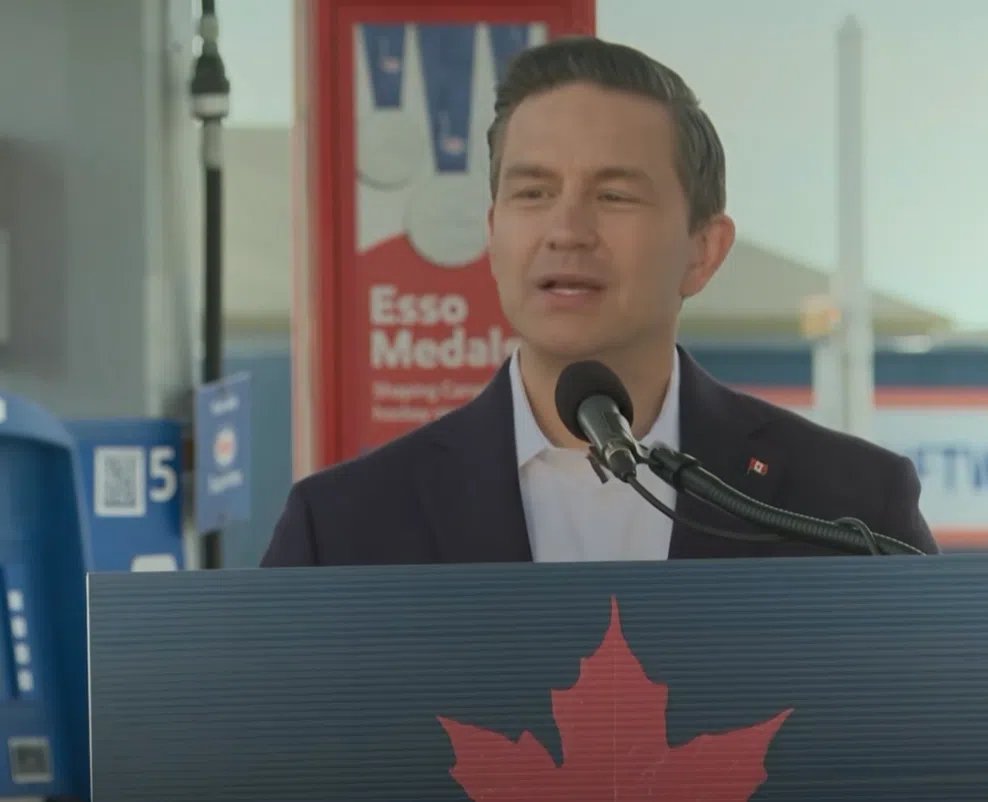
Pierre Poilievre announcing plans to reduce fuel tax
OTTAWA — Conservative Leader Pierre Poilievre is urging Prime Minister Mark Carney to introduce what he calls an emergency energy supply plan, arguing Canada should ramp up oil and natural gas production to respond to a global energy shock tied to the Middle East war.
In a letter sent Monday, Poilievre said his party will also ask the Speaker of the House of Commons to hold an emergency debate on the issue, saying energy markets are entering a period of “acute disruption.”
Poilievre pointed to rising tensions in the Middle East that he said have disrupted supply chains, slowed shipping through the Strait of Hormuz and affected liquefaction capacity in Qatar, which produces roughly one-fifth of the world’s liquefied natural gas.
He said those developments have already pushed prices sharply higher, with European natural gas prices rising about 50 per cent and oil climbing nearly 25 per cent since the conflict began to more than $90 a barrel.
Poilievre cited comments from Qatar’s energy minister warning Gulf producers could shut down production within days and suggesting it could take weeks or months to restore normal deliveries even if fighting stopped immediately. The minister also warned oil prices could reach $150 a barrel and natural gas prices could rise to four times prewar levels, Poilievre said.
The Conservative leader argued the situation has left European countries searching for secure energy supplies after trying to reduce reliance on Russian energy in recent years.
“Canada should be the answer,” Poilievre wrote.
He said Canada’s oil and natural gas resources could help stabilize global markets, support allies and strengthen the domestic economy while creating jobs and easing pressure on household energy costs.
Poilievre also accused the federal government of discouraging investment in the energy sector through regulations and taxes, citing a recent announcement by Canadian Natural Resources Ltd. that it would halt expansion plans in Canada because of what it described as regulatory barriers and the industrial carbon tax.
He said the government must remove barriers to energy development so private investors can build pipelines and other infrastructure to diversify export markets.
Poilievre called on the government to repeal Bill C-69, which overhauled federal environmental assessments, and Bill C-48, which restricts oil tanker traffic along parts of the northern B.C. coast.
He also urged Ottawa to scrap the industrial carbon tax, pre-approve liquefied natural gas plant sites on Canada’s East Coast and guarantee a maximum six-month approval timeline for major energy infrastructure projects.
Poilievre also criticized the government for failing to approve any pipelines and said Ottawa’s major projects office has not approved a single new project since receiving expanded powers last year.
Canada cannot control global conflict, he wrote, but it can decide whether its own energy resources reach world markets.
“If we remove the barriers that are holding back Canadian energy, we can help stabilize global supply, strengthen our economy and reinforce Canada’s role as a dependable partner to democratic nations,” Poilievre wrote.


Comments