


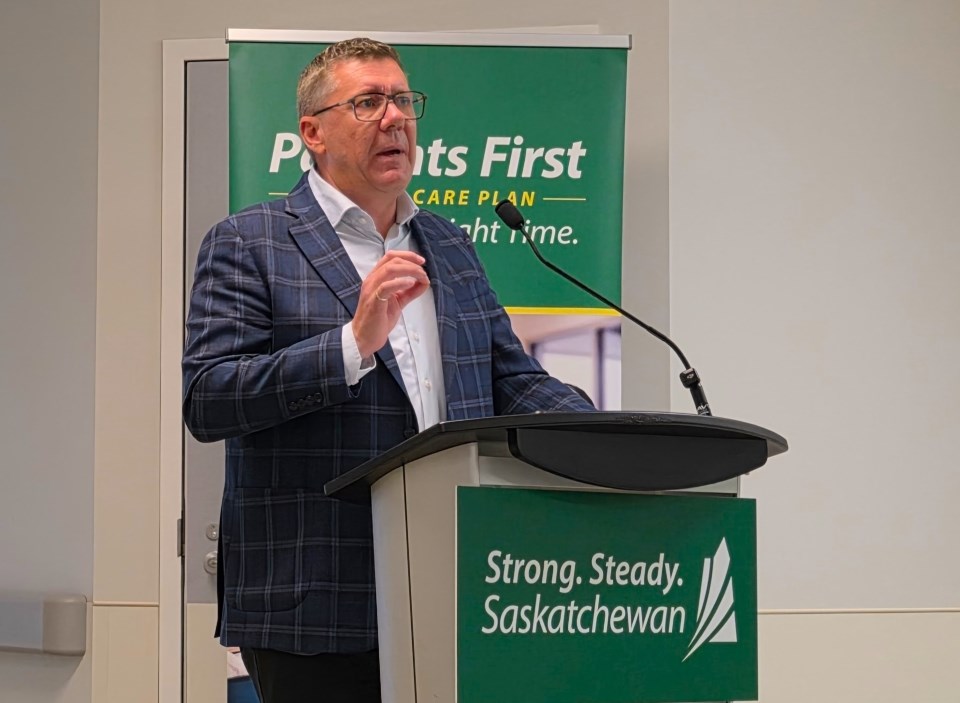
Premier Scott Moe said there is still much work to be done to address frustrations among some Canadians, after almost a quarter of Albertans voted for independence. -Jon Perez
SASKATOON, Sask. — Premier Scott Moe said Alberta’s decision to remain in Canada sends a strong message to Ottawa that co-operation between the federal and provincial governments must continue and go further to address economic concerns and strengthen the country.
Moe, during a nearly hour-long discussion with local media on Tuesday, Oct. 20, at Saskatoon City Hospital, said he was pleased that more than 76 per cent of Albertans voted in favour of remaining in Canada. Results showed Albertans overwhelmingly rejected beginning the process toward a future separation referendum.
“I’m pleased to see that strong message sent. We contribute to not only stronger provinces, but stronger provinces within that broader, stronger nation Canada,” said Moe, adding that Saskatchewan would continue working with Alberta Premier Danielle Smith and other provincial leaders to build stronger provinces within a stronger country.
Moe said the referendum should send a clear message to Ottawa that greater collaboration is welcome, but governments must keep working if they want to strengthen confidence in Canada’s future.
The Premier remained cautious despite the vote against moving toward separation, as the result also highlighted the work still needed to address frustrations among some Canadians, with almost a quarter of Albertans voting to begin the process toward a future referendum on independence.
Moe said the roughly 24 per cent who did not support remaining in Canada should not be overlooked, and the results should encourage governments and Canadians to consider why some people feel dissatisfied with the federation and take action to address their concerns.
“Let’s give them a reason to think differently in all of the decisions and actions that we do in our personal life and in our professional life,” said Moe, who added that Saskatchewan has also experienced similar frustrations with federal policies, particularly decisions he believes harmed the province economically.
Moe said his government would continue working with Prime Minister Mark Carney to improve policies introduced under previous federal leadership, which Moe described as having been implemented without sufficient consultation. Addressing those concerns is important not only for Saskatchewan but for the country’s broader economic future, he said.
“I would also very strongly say to anyone in Ottawa that would listen to a Prairie premier is we need to keep going, we need to go further in,” Moe said, emphasizing the need for continued collaboration between federal and provincial governments.
He pointed to recent federal initiatives, including Bill C-5, the establishment of the Major Projects Office and progress on major pipeline proposals, as positive steps toward attracting investment and said these measures reflected a shift toward policies that could help unlock economic opportunities in the Prairies.
Potential benefit
Moe also highlighted the referendum’s potential economic benefits, as it could attract private-sector investment amid international uncertainty, especially with more than $100 billion in private-sector capital that had been earmarked for projects across Saskatchewan, including mining, data-related industries and value-added agriculture.
He said such investments could create jobs and generate provincial royalties to help fund health care, education and municipal services, while providing more opportunities for Saskatchewan families.
Moe said Canada must also keep pursuing international partnerships and trade opportunities, especially as geopolitical conflicts and uncertainty around U.S. trade policies challenge Canadian industries.
Moe pointed to his participation in international discussions alongside Carney, including visits to China and India, as examples of the co-operation he believes is needed to expand markets and strengthen the economy. He said the federal government’s willingness to work with provinces on international relations represented a meaningful change from previous years.
Moe described the relationship between Ottawa and the provinces as co-operative federalism, arguing that governments don’t need to agree on every issue to work together where common ground exists.
“We don’t always agree. However, we need to be able to disagree without being disagreeable,” said Moe, adding that co-operation on economic development and international trade could benefit Canadians even when disagreements remain over other policies.
The Saskatchewan premier also pointed to the memorandum of understanding between Alberta and the Carney government as a step toward attracting further investment in the energy sector, saying the benefits could extend into Saskatchewan.
He said the federal government’s recent approach to major projects and international engagement had created opportunities for renewed collaboration, while acknowledging that significant work remained to address regional concerns and strengthen public confidence in the federation.
Moe said he looked forward to hearing Smith’s vision following the referendum, while emphasizing that the results should prompt governments to continue addressing the issues that led some Albertans to question their place in Canada.
He said the vote was encouraging but should not be interpreted as a reason for Ottawa or provincial leaders to become complacent. Instead, he argued, the result reinforced the need to demonstrate that working within Canada can deliver tangible economic and social benefits.
“Canada is worth that work. It is worth that effort. And for those of us who are in duly elected positions, we’re committed to improving the federation through cooperation,” said Moe, who added that the referendum offered federal and provincial leaders an opportunity to build on recent progress, address longstanding grievances and create better economic prospects for their residents.


Comments