


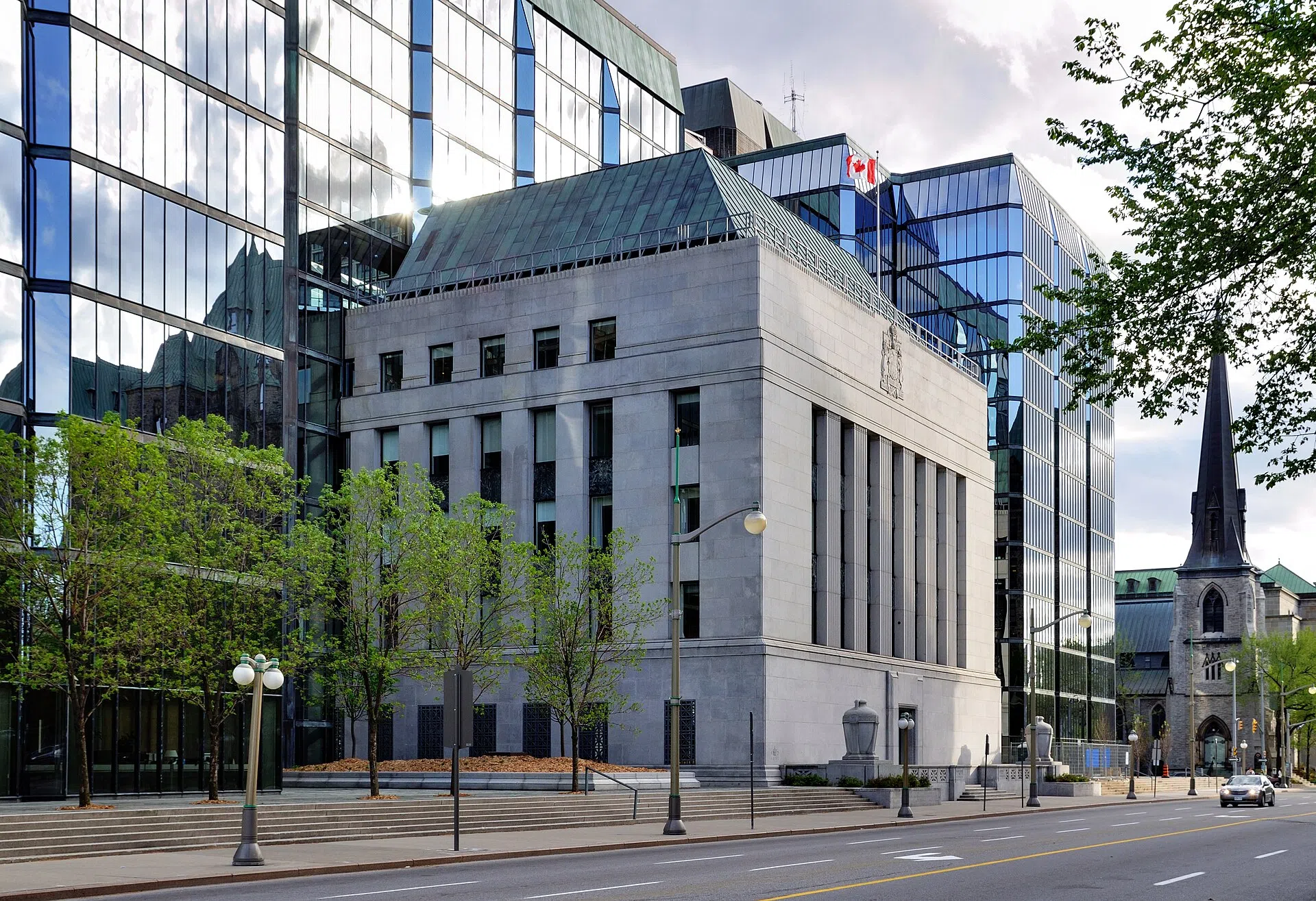
Bank of Canada Building: By Taxiarchos228, CC BY-SA 3.0, https://commons.wikimedia.org/w/index.php?curid=11974266
OTTAWA — The Bank of Canada raised its key interest rate by a quarter percentage point Wednesday, saying persistently high energy prices are increasing the risk that inflation will spread more broadly through the economy.
The central bank increased its target for the overnight rate by 25 basis points to 2.5 per cent. The Bank Rate is now 2.75 per cent and the deposit rate is 2.45 per cent.
The bank said inflation has been higher and more persistent than it expected in its July Monetary Policy Report, while economic growth has also been stronger.
CPI inflation has remained around three per cent since April and is expected to rise to about 3.5 per cent by the end of the year.
Excluding gasoline, inflation was 2.2 per cent in September, while measures of core inflation remain close to two per cent.
The bank said high fuel prices are increasing production and transportation costs, while prices for imported industrial and electronics inputs have also risen.
Businesses have largely absorbed those higher costs so far, but Bank of Canada surveys suggest more of those increases will be passed on to consumers over the next year.
The central bank said near-term inflation expectations among households and businesses have increased, although longer-term expectations remain anchored.
The continuing conflict in the Middle East is also contributing to higher energy prices and inflation pressures.
The bank now expects inflation to average three per cent in 2027, a full percentage point higher than projected in July, before declining to two per cent around the middle of 2028.
Against that backdrop, the bank said its governing council raised the policy rate to reduce the risk that high energy prices become embedded in the prices of other goods and services.
It warned further rate increases could be necessary but said policymakers intend to proceed carefully because of uncertainty in the outlook.
Canada’s economy has also performed better than expected.
Gross domestic product grew 3.3 per cent in the second quarter, while recent indicators point to growth of about two per cent in the third quarter.
The bank said consumer spending has remained solid despite slower population growth, while business investment has rebounded due in part to activity in the oil and gas sector and spending on machinery and equipment.
Exports have also strengthened despite continuing weakness in sectors affected by U.S. tariffs.
The bank attributed the improvement to strong U.S. demand, higher energy production and indications that Canadian businesses are adapting to changes in the trade environment.
The unemployment rate has remained around 6.5 per cent for several months, although the bank said a broad range of indicators continues to show some excess supply in the economy.
Growth is expected to slow during the fourth quarter as new U.S. tariffs take effect before picking up again in 2027.
The bank now forecasts the Canadian economy will grow one per cent in 2026 and two per cent in both 2027 and 2028, a somewhat stronger outlook than it presented in July.
It cautioned that the forecast remains subject to considerable uncertainty, particularly surrounding Canada-U.S. trade relations.
Globally, the bank said economic activity has remained resilient despite higher energy prices.
It raised its global growth forecast slightly to 3.1 per cent for 2026, while maintaining projections of 3.2 per cent growth in both 2027 and 2028.
The Canadian dollar weakened earlier amid U.S.-dollar strength but has since recovered to around 71 cents U.S., roughly where the bank assumed it would be in its July outlook.
The Bank of Canada’s next scheduled interest-rate announcement is Dec. 9. Its next Monetary Policy Report is scheduled for Jan. 27, 2027.


Comments