


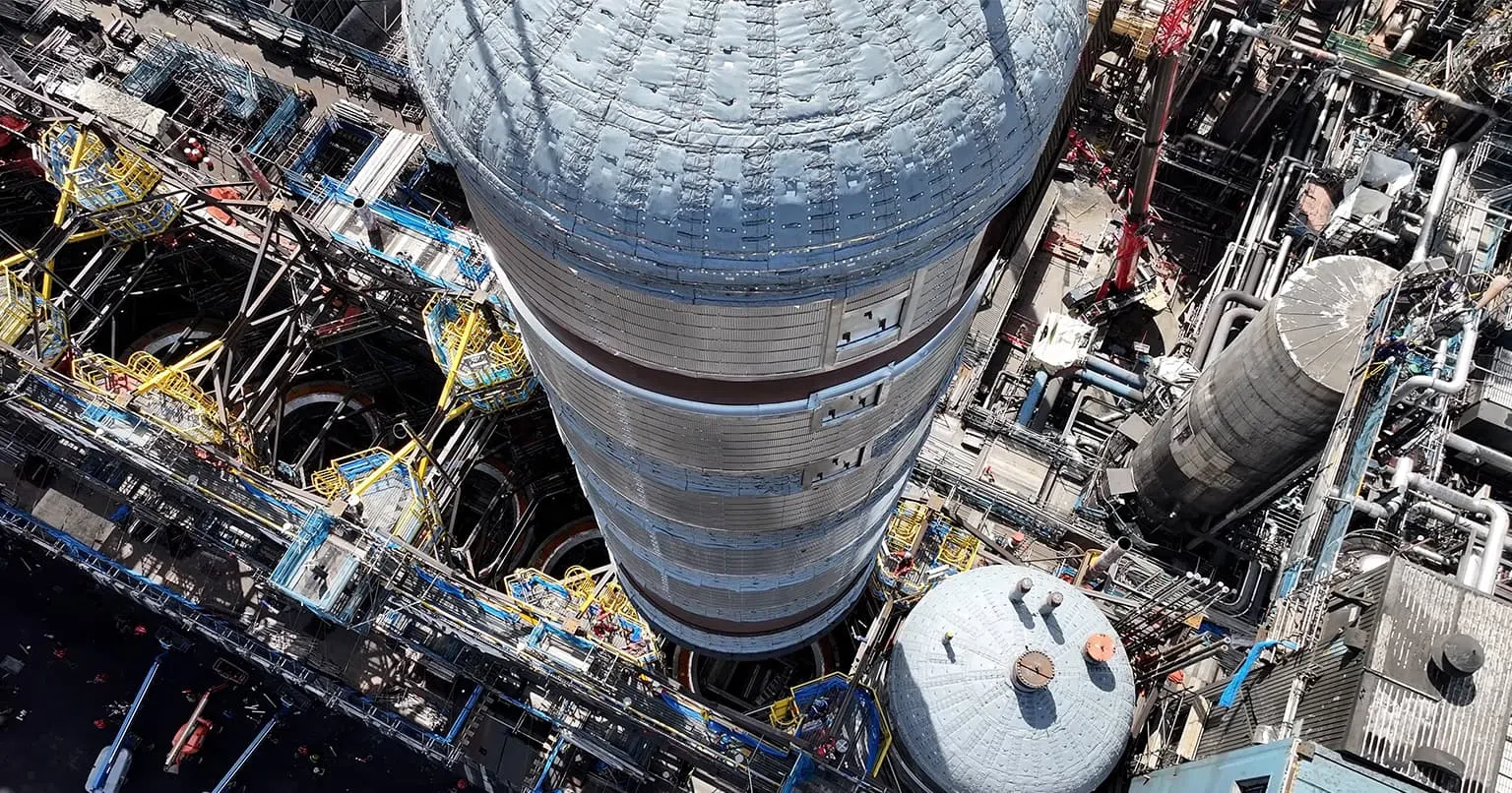
Drone photo of Coker replacement , Suncor provided image
CALGARY — Greenhouse gas emissions from Canada’s oilsands are continuing a years-long trend toward cleaner production, with emissions per barrel falling for the 13th consecutive year in 2025, according to a new analysis by S&P Global Energy.
The report found the average greenhouse gas intensity of oilsands production declined two per cent over the past year to 59 kilograms of carbon dioxide equivalent per barrel, extending a trend that has reduced emissions intensity by 31 per cent since 2009.
The findings are particularly significant for northeastern Alberta, where oilsands operations around Fort McMurray account for the vast majority of Canada’s bitumen production.
S&P Global Energy said the reductions reflect years of incremental operational improvements rather than a single technological breakthrough. Mining operations posted the largest gains through better fleet optimization, improved waste heat recovery, predictive maintenance programs and shorter maintenance shutdowns.
The analysis also points to larger investments, including carbon capture technology and equipment upgrades, along with a growing share of production coming from lower-intensity extraction methods such as steam-assisted gravity drainage.
While emissions intensity continued to decline, total greenhouse gas emissions increased by two per cent between 2024 and 2025 as production reached record levels.
Overall oilsands production grew by about 150,000 barrels per day during the same period, meaning production increased at more than twice the rate of emissions growth.
S&P Global Energy said the industry’s newest production is also becoming more efficient. It estimated additional barrels produced in 2025 carried an emissions intensity of about 33 kilograms of carbon dioxide equivalent per barrel, well below the industry average of 59 kilograms.
The report notes emissions intensity measures the greenhouse gases required to produce a single barrel of oil, while absolute emissions measure the industry’s total greenhouse gas output. Because production continues to grow, total emissions can increase even as each individual barrel becomes less carbon intensive.
“The downward trajectory of oilsands emissions intensity is now a well-established, multi-decade trend,” said Kevin Birn, vice-president and head of carbon research at S&P Global Energy.
“Ongoing optimization efforts to maximize output from existing facilities, which are much more capital efficient compared to new projects, has been a critical factor, and this is expected to continue.”
The report cautions total emissions would likely continue rising if production accelerates without wider deployment of carbon capture and storage technology. However, it concludes operational improvements made over nearly two decades continue lowering the emissions associated with each barrel produced, strengthening the competitiveness of Canadian oilsands production in a market increasingly focused on lower-carbon energy sources.


Comments