


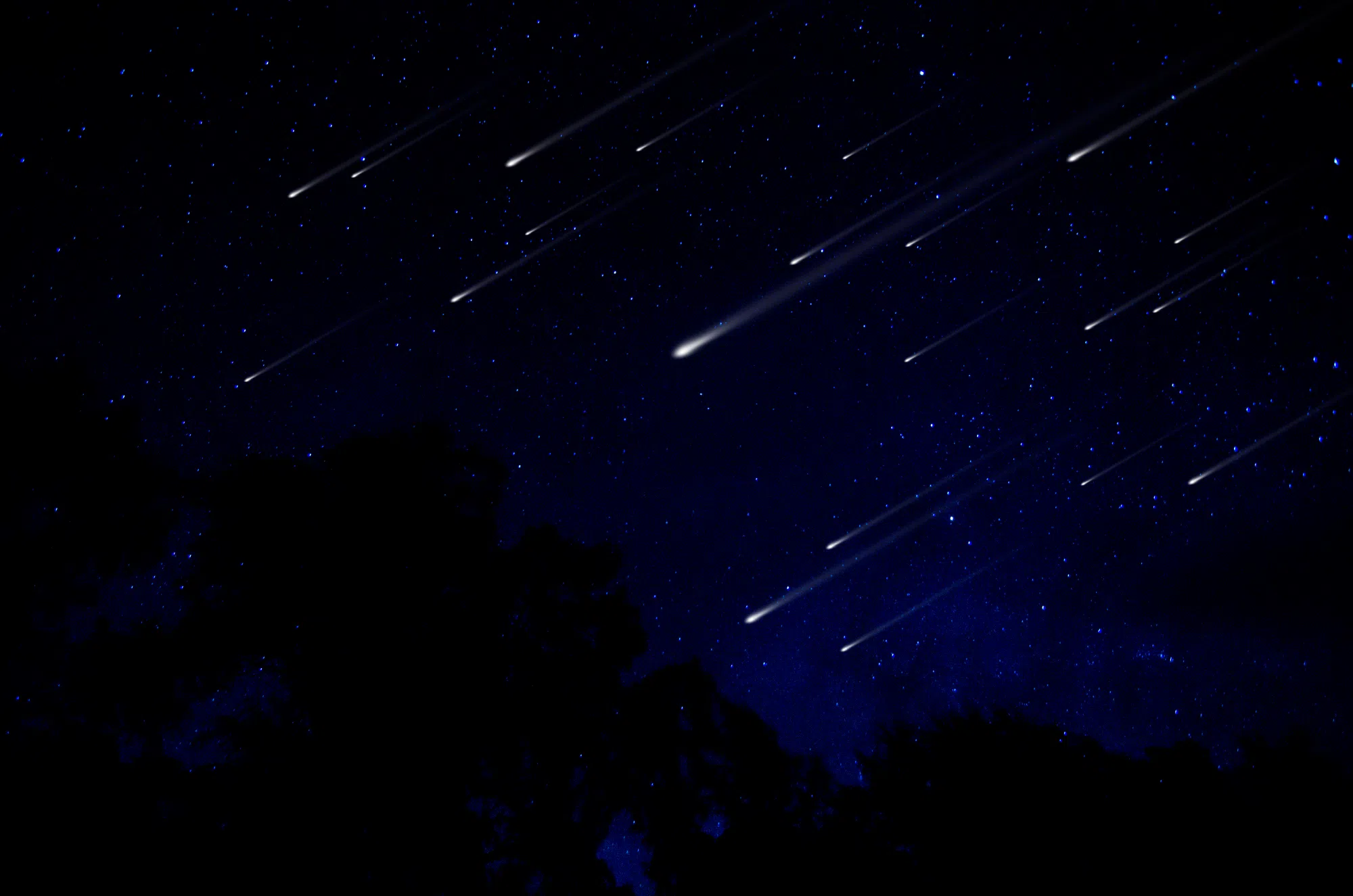
FORT McMURRAY — A summer meteor shower is beginning to produce shooting stars over the Northern Hemisphere, offering skywatchers several weeks of activity before reaching its peak near the end of July.
The Southern Delta Aquariid meteor shower is active from mid-July through August, with activity gradually increasing as Earth moves deeper into a stream of debris associated with Comet 96P/Machholz.
Unlike meteor showers with brief and pronounced peaks, the Southern Delta Aquariids produce relatively steady activity over several weeks.
The shower is expected to reach maximum activity around July 30, when up to 25 meteors per hour could be visible under ideal conditions.
However, a nearly full moon will brighten the sky during this year’s peak, making many of the shower’s fainter meteors difficult to see. (American Meteor Society)
Richard Covey, an astrophotographer and member of the Royal Astronomical Society of Canada, said the gradual nature of the shower means observers do not necessarily need to wait until peak night.
“The Delta Aquariids are more of a marathon than a sprint,” Covey said. “They slowly build through the second half of July, so any clear night over the next few weeks could produce a few meteors.”
The shower favours observers in the Southern Hemisphere, where its radiant point climbs higher into the sky, but meteors can also be seen from Canada.
The radiant, or point from which the meteors appear to originate, is located in the constellation Aquarius. From northern latitudes, observers generally have better opportunities during the hours after midnight when Aquarius is higher above the southern horizon.
Covey said people should avoid concentrating exclusively on Aquarius when watching for meteors.
“You don’t need a telescope, binoculars or even to know where Aquarius is,” Covey said. “Find the darkest place you safely can, give your eyes 20 or 30 minutes to adjust and watch as much of the sky as possible.”
The Southern Delta Aquariids are generally faint, medium-speed meteors travelling through Earth’s atmosphere at about 41 kilometres per second.
Researchers believe the shower is associated with Comet 96P/Machholz, although astronomers have historically debated the precise origin of the debris stream.
As Earth passes through the stream, small particles enter the atmosphere and produce streaks of light as they heat the surrounding air.
The Southern Delta Aquariids will also begin overlapping with the Perseid meteor shower later this month, gradually increasing the number of meteors visible during the overnight hours.
Covey said distinguishing between the showers can be done by tracing a meteor’s path backward across the sky.
“If the path leads back toward Aquarius, you’ve probably caught a Delta Aquariid,” Covey said. “If it traces back toward Perseus in the northeast, you’re looking at an early Perseid.”
The Southern Delta Aquariids are expected to remain active into August, while the Perseids will continue building toward their peak in mid-August. (earthsky.org)


Comments