


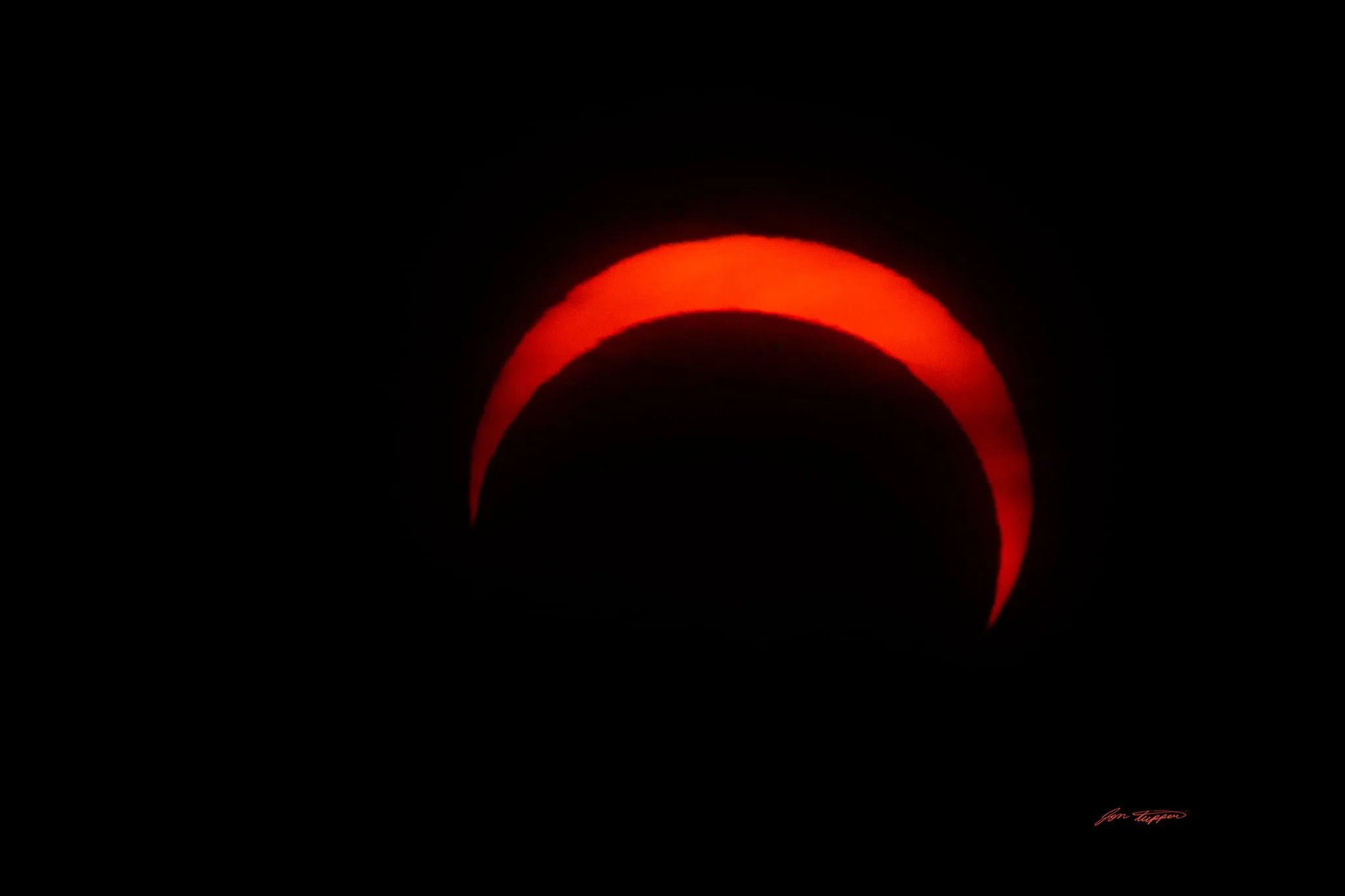
Partial Lunar Eclipse, image by Jon Tupper
FORT McMURRAY — This morning Fort McMurray will be treated to a partial solar eclipse. While most people won’t notice any change, at 10:42 about 14 per cent of the sun’s disc will be eclipsed by the moon.
The eclipse begins at 9:56 a.m., reaches maximum coverage at 10:42 a.m. and ends at 11:28 a.m., giving local skywatchers about an hour and a half to follow the moon’s passage across the sun.
Richard Covey, a member of the Royal Astronomical Society of Canada and avid amateur solar observer, says the relatively small eclipse means people shouldn’t expect the dramatic darkening associated with a total eclipse.
“If you didn’t know it was happening, you could probably go through your morning without noticing anything unusual,” Covey said. “But with the proper equipment, you’ll clearly see the moon taking a bite out of the sun.”
Covey says anyone planning to watch should use proper solar viewing equipment and never look directly at the sun without appropriate protection. Shade 14 welding glass or a solar filter designed for astronomical use can be used to follow the eclipse.
A properly filtered cellphone camera can also capture the changing shape of the sun during the event.
“The important thing is making sure the filter is between the sun and whatever you’re using to observe it,” Covey said. “Once you’ve taken care of the safety side, a partial eclipse is actually very easy to enjoy.”
And Wednesday’s eclipse is only the beginning of a busy day overhead.
The annual Perseid meteor shower reaches its peak Wednesday night into Thursday morning, with particularly favourable conditions this year because the new moon will leave the sky free of moonlight.
People willing to get away from Fort McMurray’s city lights could see between 60 and 120 meteors an hour under ideal conditions.
Covey says around midnight is a good time to head outside, find a dark location and look toward the northeast.
“The Perseids are one of those astronomical events where you don’t need any equipment,” Covey said. “Find a dark place, give your eyes some time to adjust and look up. The darker your sky, the more you’re going to see.”
Mars will also be rising above the horizon, adding its distinctive reddish colour to the nighttime display.
Binoculars can provide another target. About 25 degrees above the horizon, observers can look for what appears to the naked eye as a bright white star.
Through binoculars it takes on an oval appearance, while greater magnification reveals the rings of Saturn.
The planet’s famous rings are once again tilting toward Earth after appearing nearly edge-on, gradually restoring one of the most recognizable sights in amateur astronomy.
“Saturn is one of those objects people remember the first time they see it through a telescope,” Covey said. “The rings are coming back into a better viewing angle, and it really is one of the prettiest things in the night sky.”
Between a partial solar eclipse in the morning, the Perseids after dark and several planets to find along the way, Wednesday offers something for everyone from casual skywatchers to dedicated amateur astronomers.
And for anyone planning to catch both ends of the show, it might be a good morning to order the double-double.


Comments